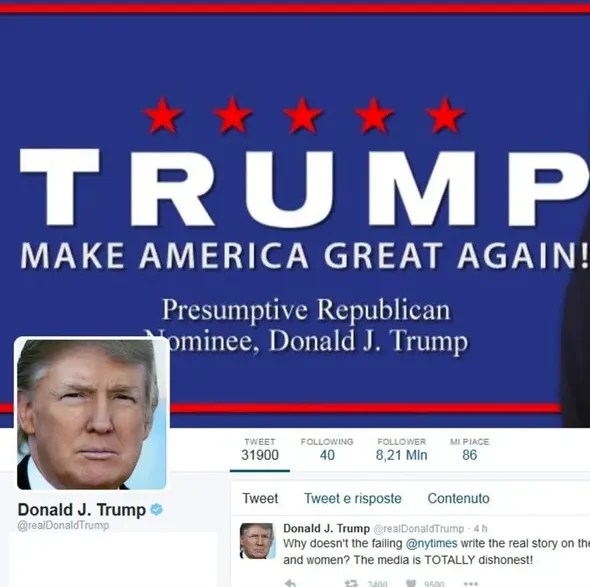
His Twitter following is growing by one million people a month. On television, he hosted the hit reality show The Apprentice. Here is why the Republican candidate is the perfect product of a hybrid age, suspended between television and the internet—and why he could win.
Originally published in Italian for on L’Espresso
Among the many explanations offered to make sense of Donald Trump’s surprising rise during the Republican primaries, one of the most original comes from Nicholas Mirzoeff, professor of Visual Culture at New York University. According to Mirzoeff, Trump represents the emergence in politics of a new media reality: a dimension in which the cultural legacy of reality television merges with the ever-expanding universe of social media.
Viewed through this lens, the “Trump phenomenon” combines elements of both worlds: the world of reality television, a cultural model centered on the possibility of achieving near-instant celebrity through popular voting, and the world of social media, built upon interactivity and constant connectivity. Trump thus emerges as a hybrid political figure situated between two eras—that of television and that of the internet—in an interregnum where the echoes of an old model have not yet faded, while the language of a new generation is still taking shape. It is surely no coincidence that Donald Trump hosted one of television’s most successful reality series, The Apprentice, while simultaneously proving himself a shrewd communicator on Twitter, where his followers have been increasing by roughly one million every month since January.
But how exactly does Trump succeed in bridging the worlds of television and the internet? To better understand this connection, it is useful to listen to Trump’s own supporters, who consistently describe the businessman—with his unmistakable flair for spectacle—as someone who “tells it like it is.” He tells it like it is, his enthusiastic fans repeat. According to a recent New York Times study, this was precisely the reason why voters in thirteen states supported Trump during the Republican primaries. This finding is especially noteworthy in light of an ABC News/Washington Post poll showing Trump leading Hillary Clinton by two percentage points in voter preferences ahead of the November presidential election. If Donald Trump is rewarded for speaking bluntly and directly, unconstrained by the conventions of political correctness, Hillary Clinton has often been criticized for lacking “authenticity.”
According to reality television scholar Matthew Wheelock Stahl, the ability to project authenticity is recognized as one of the defining qualities of successful reality TV contestants. The intimate, confessional, and often voyeuristic environment created by reality television rewards personalities who appear genuine, real, and believable—individuals capable of generating emotional or cultural affinity among viewers—even if much of their behavior is, in fact, carefully guided by the show’s producers. The preferences expressed by Trump’s supporters suggest that the very qualities considered essential for success in a reality show are now also expected of political candidates: what matters is not so much what politicians say, but whether they appear to say it authentically. It is worth recalling that when Sarah Palin burst onto the national stage in 2008, many observers remarked that the Republican vice-presidential candidate seemed to have stepped straight out of a reality show—not only because of her unconventional and often inelegant style, but also because of her ability to connect with the most conservative and economically disadvantaged segments of the American electorate.
Following Sarah Palin’s awkward and grammatically shaky endorsement of Trump in January, it became increasingly clear that the businessman was positioning himself as the champion of a form of television-driven populism that still commands strong support among Republican voters, particularly those aligned with the Tea Party movement. It mattered little that President Obama warned that the presidency of the United States is not a reality show. Frustrated voters, who had upended the Republican Party’s internal balance, had found in Donald Trump their favorite contestant: the most authentic, the most fearless, the one most capable of amplifying popular frustration with Washington politics, anger over the perceived injustices of the global economy, and fears surrounding war, terrorism, and uncontrolled migration.
These emotions may well have been genuine. Yet, as in every reality show, they were carefully edited and amplified by Trump himself, who displayed an exceptional instinct for controversy and an uncanny ability to create memorable catchphrases. From Build the Wall!—the slogan attached to his controversial proposal to build a border wall with Mexico, which became a mantra at every Trump rally—to Get ’em out!, shouted by supporters at protesters who disrupted his campaign events, Trump demonstrated a remarkable talent for transforming political messages into viral slogans.
If reality television provided the cultural soil from which Donald Trump’s political phenomenon grew, social media became its antennae: the channels through which the future Republican presidential nominee maintained a constant presence in the public sphere. While on The Apprentice he served merely as producer and host, the daily show he stages through his Twitter account has made Trump its producer, director, and leading actor. The medium is entirely under his control. He manages it personally, communicating and interacting without filters with more than eight million followers.
If the language of reality television is what media scholars call semi-scripted—partly written and partly improvised—social media pushes immediacy and spontaneity even further. Short, emotionally charged statements, crafted through well-tested rhetorical formulas; language reportedly written at a fourth-grade reading level; and the repeated use of mocking nicknames—Crooked Hillary being the latest example—to discredit opponents. This is the strategy, and so far it has proved remarkably effective.
Trump appears to have understood better than most the capacity of social media to generate viral phenomena. His venomous attacks on political rivals produce thousands of likes, retweets snowball into virtual avalanches, and hashtag campaigns achieve the critical mass necessary to become news stories in their own right. Traditional media then amplify these trends, providing Trump with enormous visibility and free publicity while overturning the conventional rules of electoral campaigning.
This unstable mixture of influences—from reality television to social media—appears to have provided Donald Trump with the most effective weapon for navigating the chaotic Republican primary season. Now, however, a different phase begins, with the highest possible stakes: the presidency of the United States.
Some recent signals suggest that Trump intends to restore more conventional political rules, abandon some of the personal attacks, and repair relations with the Republican establishment. Yet while Trump succeeded during the primaries in defying both the political system and the traditional media with a boldness no previous candidate had dared to display, it will be far more difficult to evade scrutiny and disappoint the expectations of the national audience.
If Americans chose him as a vehicle for expressing their anger and disillusionment, he will not be able to shed that role so easily.
 Gabriele Cosentino