Gabriele Cosentino

Media, Culture & Global Politics

Tag: Egypt

  • An Anniversary and a Reckoning: 10 Years after the Murder of Giulio Regeni in Cairo

    An Anniversary and a Reckoning: 10 Years after the Murder of Giulio Regeni in Cairo

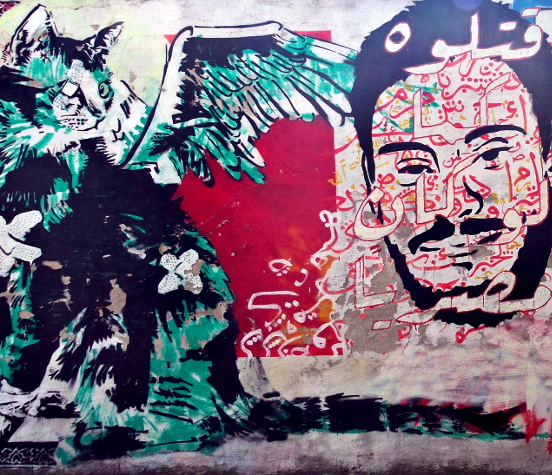
    Photo credits: El Teneen

    January 25, 2016, was not an ordinary day in Cairo. It marked the fifth anniversary of the 2011 Egyptian uprising, at a time when the country was still reeling from the convulsions unleashed by the Arab Spring. The city center was heavily patrolled to prevent people from organizing protests against the increasingly repressive government led by Abdel Fattah al-Sisi, or even from commemorating the revolution that had ended Hosni Mubarak’s 30-year rule. That evening, the Italian doctoral student Giulio Regeni entered a subway station in Cairo’s Dokki neighbourhood to meet friends at a birthday party—and disappeared.

    Nine days later, his half-naked body was found by a bus driver, dumped in a ditch along the Cairo–Alexandria freeway, bearing horrific signs of torture. Initial police reports described his death as the result of a car accident or a botched burglary, and clumsy cover-ups were staged. But Regeni’s disfigured body bore the unmistakable hallmarks of an extrajudicial killing by state security. Autopsies revealed that he had been interrogated and tortured for up to seven days before being killed. His mother later said she could identify him only from “the tip of his nose.”

    At the time of his death, Giulio Regeni was a young researcher at Cambridge University. He was in Cairo conducting fieldwork for a doctoral dissertation on independent labor unions, with a particular focus on street vendors. During his stay, Regeni was affiliated with The American University in Cairo (AUC), a prominent private institution through which he was able to establish contacts for his research. Fluent in Arabic, he mingled with street vendors in Cairo’s busy streets to observe their work and study their efforts at unionizing. His research topic was politically sensitive—labor unions had played a role in the 2011 uprising—but not, at the time, considered life-threatening. Prior to Regeni’s death, foreign researchers in Egypt had not been subjected to lethal violence by state security. But by 2016, Egypt was gripped by anti-foreign paranoia, fueled by government propaganda portraying the 2011 revolution as the product of a foreign conspiracy.

    For nearly a decade, the Regeni family, Italian institutions, and a broad segment of Italian public opinion have fought an uphill battle to uncover the truth and hold those responsible accountable. After painstaking investigative work by Italian prosecutors—conducted amid sustained obstruction by Egyptian authorities—four agents of Egypt’s National Security Agency are now standing trial in Rome. They are accused of kidnapping and torturing Regeni to death. The trial, however, is proceeding in absentia, as the Egyptian government denies their involvement and refuses to disclose their whereabouts. The investigation has revealed that Regeni was under surveillance by the security apparatus from the moment he arrived in Egypt, and that the National Security Agency had built a network of informants monitoring his activities. Among them were a close friend, Noura Wahbe, a former AUC professor, and a labor union organizer, Muhammad Abdullah.

    I worked at the American University in Cairo until recently, where I served as an assistant professor in the Journalism and Mass Communication Department. I have fond memories of my time at AUC, but my experience there was haunted by the murder of Giulio Regeni—a subject that was as distressing as it was dangerous to discuss, even privately, with friends and colleagues. My office was in the same building as Noura Wahbe’s. I contacted her several times seeking to discuss the case, but to no avail. Another AUC faculty member, Rabab El Mahdi, helped Regeni get in touch with the National Security Agency informant whose involvement ultimately led to his kidnapping. When I raised the subject of Regeni with colleagues, I was told to drop it: it would reopen painful memories and could endanger those who had known him.

    This is what it means to live under a brutal military regime that does not respect human rights. You constantly fear that raising certain topics may cost you your job, your freedom, or even your life. Former and current AUC faculty members could provide crucial testimony in the Regeni trial, yet institutional reluctance has helped preserve impunity and emboldened a violent regime. According to the European Parliament, Regeni’s murder was not an isolated event but part of a broader context of torture, deaths in custody, and forced disappearances—abuses that surged after Abdel Fattah al-Sisi seized power in the 2013 coup.

    The Regeni case is not only about Egypt. It exposes how Western higher education institutions operating abroad, along with strategic alliances, can enable repression while professing democratic values. The democratic erosion now troubling the United States was foreshadowed in Egypt, a key partner, where the rights of a young academic were brutally violated with total impunity, and where civic freedoms have been systematically dismantled, betraying the aspirations of the Arab Spring.

    On the tenth anniversary of Giulio Regeni’s death, the American University in Cairo could take a crucial step by fully cooperating with Italian prosecutors and sharing all relevant information needed to bring those responsible to justice. Such an act would send a powerful signal that U.S.-accredited institutions of higher education still stand for democracy, liberal values, and the protection of human rights.
  • TikTok in Egypt: Where Rich and Poor Meet – and the State Watches Everything

    TikTok in Egypt: Where Rich and Poor Meet – and the State Watches Everything

    Khaled Desouki/AFP/Getty Images

    Published in The Conversation


    After being released from detention in 2011, Egyptian engineer and activist Wael Ghonim told the media:

    If you want to liberate a society, all you need is the internet.

    He’d been taken into custody for his role in the revolution that toppled the regime of Hosni Mubarak. Part of the success of this unprecedented popular uprising was due to the role of social media in mobilising citizens around a common political cause.

    In 2025, after a decade under the repressive government of Abdel Fattah el-Sisi, it’s fair to say that little has remained of Ghonim’s vision. Social media use in Egypt is closely guarded by the authorities to detect signs of opposition. Citizens are routinely detained, even for the slightest criticism of the government.

    In 2018 Egypt introduced a new law, apparently to curb the problem of online misinformation and disinformation. This law is, in reality, often used to stifle dissent. Egyptians today operate within unclear boundaries of what is permissible to say online. The result is widespread self-censorship for fear of arrest.

    As a scholar of political communication and new media I’ve written books on global social media. I teach students about the social and political impact of digital and social media in Egypt. The video sharing platform TikTok is a frequent subject in my classes because it reveals both the liberating and the repressive effects of social media use in Egypt.

    TikTok stands out for its ability to create viral videos and sudden micro-celebrities. This has made it a lightning rod for government crackdowns. But it has also connected people across socio-economic divides and bred a lively new cultural and political debate – one that’s not as easy for the government to police.

    TikTok in Egypt

    Since 2020, TikTok has become immensely popular in Egypt, with an estimated 33 million users over 18 years old.

    While TikTok hasn’t taken on the explicit political dimension that Facebook or Twitter did over a decade ago, it has already become the theatre of a series of incidents that have landed its users in the crosshairs of the authorities. This has exposed political rifts and tensions.

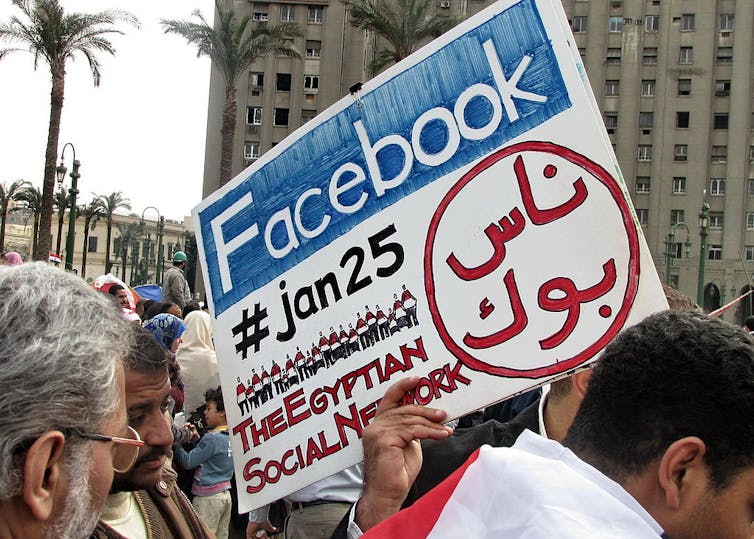
    People in a crowd, a hand holds up a placard that reads
     
    Facebook was the prominent social media during the revolution. Sherif9282/Wikimedia Commons

    Most of the incidents are related to the ability of TikTok to work as a “virality engine” – even users with few followers can gain a sudden and sometimes problematic celebrity.

    But while Egyptian authorities have evidently been cracking down on TikTok users, there have been no concrete plans to ban the platform. In fact, some government branches have used it to advance their own initiatives. The Ministry of Youth and Sports, for example, signed an agreement with TikTok to launch the Egyptian TikTok Creator Hub, designed to educate youth on using social media responsibly.

    Women targeted

    Since 2020, Egyptian authorities have arrested TikTok users under charges ranging from the violation of family values to the spread of false information and allegations of belonging to terrorist organisations. Most of these TikTokers didn’t post explicit sexual or political content, making the charges against them appear exaggerated. These cases suggest the authorities are closely monitoring the platform, following strict moral and political considerations.

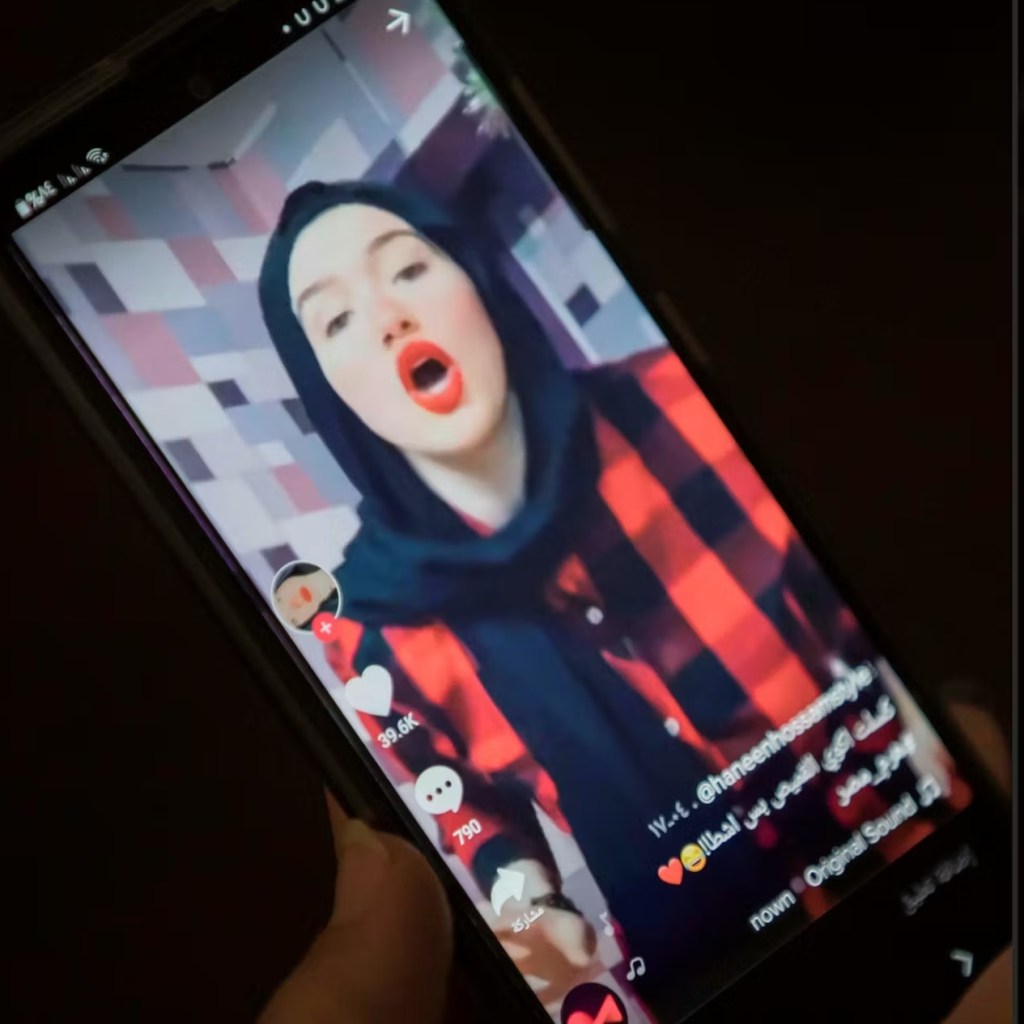
    The most high profile cases have involved young women, most notably Haneen Hossam and Mawada Eladham, who were arrested in 2020 for violating family values. Article 25 of Egypt’s anti-cybercrime law states that content “violating the family principles and values upheld by Egyptian society may be punished by a minimum of six months’ imprisonment and/or a fine”. It leaves the definition of family values purposefully vague.

    Observers have noted that this vagueness has allowed the law to be applied in a range of different cases. More than a dozen women have faced similar charges, endured pretrial detention and been handed lengthy prison sentences.

    The arbitrary nature of many of the charges suggests a possible deeper motive: policing the presence of young women in digital spaces where they can gain influence and financial independence outside traditional family or work structures.

    TikTok has given ordinary users in Egypt unprecedented visibility, in some cases allowing them to challenge social norms, often through humour. This appears to have unsettled authorities, who appear to have sought to send a message to the broader population.

    Arrests

    TikTok-related arrests have not been limited to family values. In 2022, three users were arrested for criticising rising food prices. They were charged with spreading fake news, despite the fact that inflation in Egypt was rising sharply.

    In 2023, a parody skit of a fake jail visit by a TikToker went viral. The creators were arrested and charged with belonging to a terror organisation, spreading fake news and misusing social media.

    Such arrests indicate that TikTok content that touches on politically sensitive matters, even in jest, is posing a new type of challenge for the Egyptian government. The state is particularly concerned with viral content that might bring attention to its poor human rights record. This includes notoriously bad conditions in jails.

    ‘Egypt’ and ‘Masr’

    At the same time, the platform is proving able to connect people from very different social and economic backgrounds, as it is seen to do globally.

    Egypt is very hierarchical. Small, affluent elite groups live in a separate and secluded socio-economic reality from the majority of the population. Thirty percent of Egyptians live under the poverty line.

    On TikTok, the more privileged, cosmopolitan section of society is referred to as “Egypt”. The poor and disenfranchised are “Masr” (مصر), the Arabic word for Egypt.

    TikTok is aimed at generating viral content more than it is a networking site, like Facebook, that’s based on pre-existing social connections. The result is a virtual common space where the two sides can interact in new ways. This engenders unique social and cultural dynamics also observed in other countries.

    “Egypt” watches “Masr” create all kinds of content – from singing and dancing routines to live begging. “Masr” gets to peek into the otherwise inaccessible world of the wealthy.

    In the current climate of an economic crisis, this divide can be glaring. While most Egyptians are struggling with inflation, the cost of living and unemployment, the wealthy flaunt their lifestyles on TikTok.

    When wealthy TikTokers post content complaining about relatively petty issues like a long wait for valet parking at a luxury restaurant or boast about their weekly allowance, it reveals their disconnect from the everyday hardships faced by the less privileged.

    Users are able to comment freely on each other’s videos, sharing their unvarnished opinions. A student boasting about their weekly allowance of 3,000 EGP (US$60) might be told, “This is some people’s monthly salary.”

    Political consequences

    Since it first appeared in 2020, TikTok in Egypt has evolved from a platform mainly geared towards silly and entertaining content by teenagers. It’s become an outlet for people of all ages interested in gathering information, keeping abreast of current trends and events, and also a space for political engagement, especially on the issue of Palestine.

    There hasn’t been an obvious politicisation of TikTok in Egypt yet and there might never be, given the strict policing by authorities. But TikTok’s ability to expose divisions in Egyptian society and connect citizens across demographic cleavages could potentially have unexpected political consequences in the near future.

    Shahd Atef contributed to the research for this article